New Year, New parkrun: The £15 Kit Item Most Beginner Runners Skip
January parkruns start under the year's lowest sun. The three pain points new runners hit, a 30-second fit test, and when not to buy anything at all.
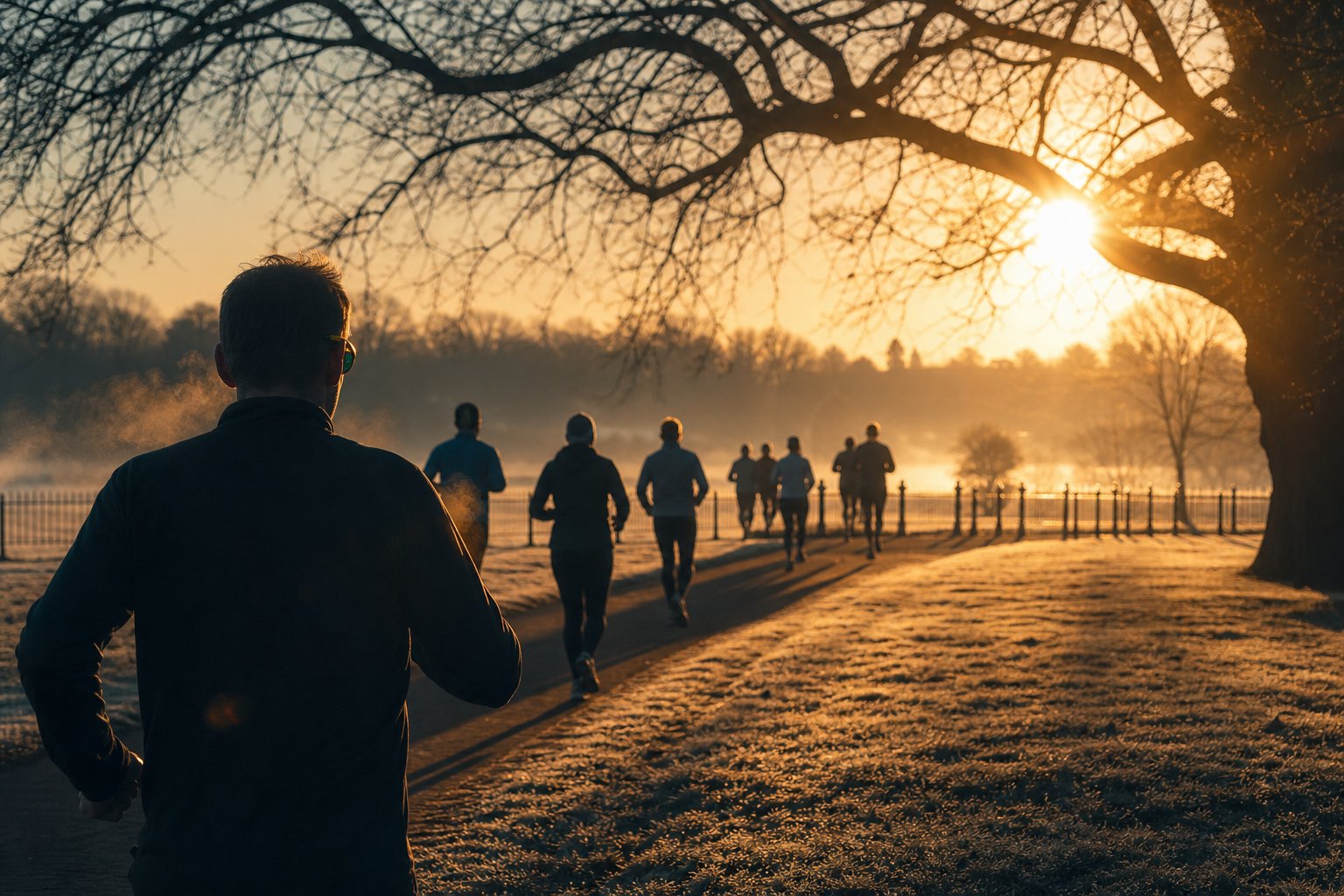
New runners buy shoes, then a watch, and think about their eyes last — yet January parkruns start under the lowest Saturday-morning sun of the entire year. A £15.31 polarised wraparound fixes the three problems beginners actually hit: sweat-slip, bounce and wind-watering eyes. Here is how to choose one, fit it, and know when you genuinely don’t need it.
Why January is the lowest-sun month in the parkrun calendar
A 9am January start puts the sun lower in the sky than anything November or December manages at that hour. Across the five London parkrun Saturdays of January 2027, our glare-window model puts the sun between just 5.3° and 9.0° above the horizon at the start whistle.
| Saturday | Sunrise (London) | Sun elevation at 9:00 |
|---|---|---|
| 2 January | 08:07 | 5.3° |
| 9 January | 08:04 | 5.7° |
| 16 January | 07:59 | 6.5° |
| 23 January | 07:52 | 7.6° |
| 30 January | 07:43 | 9.0° |
On 2 January, sunrise is barely fifty minutes before the start whistle. Those angles are lower than the same 9am slot in November — the month every low-sun article is actually written about. The numbers come from our glare-window model, the same NOAA-based calculation behind our UK commuter glare rankings; the event-specific deep dive lives in our winter parkrun low-sun guide.
On the ground it means this: any east-pointing straight on the course puts the sun directly in your eyeline, low enough to duck under a cap peak. And if you have just signed up for your first free weekly 5k, you will not be alone out there in January — more elbows, more buggies, more dogs on long leads, all navigated while squinting.
The three problems beginners actually hit
Sweat makes glasses slide, running makes them bounce, and cold January air makes unprotected eyes stream — those three complaints come up far more often among new runners than any question about tint or brand.
Sweat-slip. Beginner-running forums return to the same complaint every week: glasses that surf down a sweaty nose from the second kilometre. The engineering answer is contact material. Our AeroShield Pro uses hydrophilic rubber at the nose and temples — a compound that grips harder as it gets damp, not looser — and adjustable nose pads that let you set the contact angle for your own face.
Bounce. Running loads a frame in a way cycling never does: a vertical jolt with every footstrike. Weight decides the outcome. At 28g in a TR90 frame there is very little mass to get moving, and the 148mm wraparound arc spreads grip along the whole temple instead of pinching at two points behind the ears.
Wind-watering. Cold moving air dries the front of the eye, and the eye answers by streaming — the classic January finish with tears down both cheeks. A wraparound shield takes that airflow off the eye surface, the frameless lower edge keeps kerbs and potholes in clear view, and the vented top edge stops the inside misting when you slow to a walk. This is exactly why cycling wraparounds beat fashion frames for running — the full argument is in running in cycling glasses.
The 30-second fit test
Three checks catch almost every bad fit before it ruins a run: look down at your shoes, shake your head hard, then jump five times — if the glasses stay planted through all three, they will survive a 5k.
Look at your shoes and hold it for ten seconds; if the frame creeps forward, steepen the nose pads. Shake your head, a firm no in each direction; movement at the temples means the arc is too wide for your face. Jump five times on the spot; this is the combined stress test, and glasses that pass it do not move at parkrun pace. Our fit checker walks you through the same three checks step by step. A frame that passes simply disappears from your attention — which is the entire point of a running frame.
When you shouldn’t buy these
If your January running happens on a treadmill or in a midday gym class, you don’t need sports sunglasses — spend the money on socks. And a dark lens on a genuinely overcast morning is the wrong tool even outdoors.
Our lenses are polarised Category 3, built for genuine brightness. On a flat-grey January morning a Cat 3 lens just makes a dim world dimmer. The right end of our range for gloom is the lighter pair of tints — C20 light smoke or C24 pink-rose, which lift contrast without stealing light — and on the darkest, murkiest mornings the honest answer is no glasses at all rather than the wrong ones. We don’t make a clear lens, and we would rather tell you that than sell you a dark one for the dark.
Which colour for a 9am winter parkrun
For bright, crisp January mornings, dark smoke C1 or silver mirror C4 handle direct low sun; for murky grey starts, light smoke C20 or pink-rose C24 lift contrast without dimming the world. Most runners’ honest answer is one of each.
The full mapping of all eight lens colours to British conditions — including which tints suit changeable skies — is in our lens colour guide.
FAQ
Do beginner runners really need sunglasses in winter? Nobody needs them the way they need shoes. But of everything on the beginner kit list, this is the cheapest fix for the most common complaints: low sun in your eyes at 9am, wind-watering on cold straights, and the squint that tightens your whole face for 5k.
Are cycling glasses OK for running? Yes — the demands are the same: stay put, block wind, survive sweat. A wraparound sports frame does both jobs; the differences that matter are weight and grip, not the sport on the label.
What if they don’t fit my face? Run the three-part fit test above and adjust the nose pads first — that fixes most slippage. If the shape is genuinely wrong for you, our 30-day free returns exist precisely so a fit gamble costs you nothing.
The First-Kit Rule. Buy the boring kit once and buy it sensibly: one dark pair for bright mornings, one light pair for grey ones — £27.56 for both with the discount applied automatically. Build your 2-pack and stop thinking about your eyes mid-run.