Cycling in Low Winter Sun: The UK Commuter's Glare Survival Guide
Low sun causes 28 UK road deaths a year — 74% are cyclists, walkers, riders. How to see and be seen on dazzling commutes, and which lens helps.
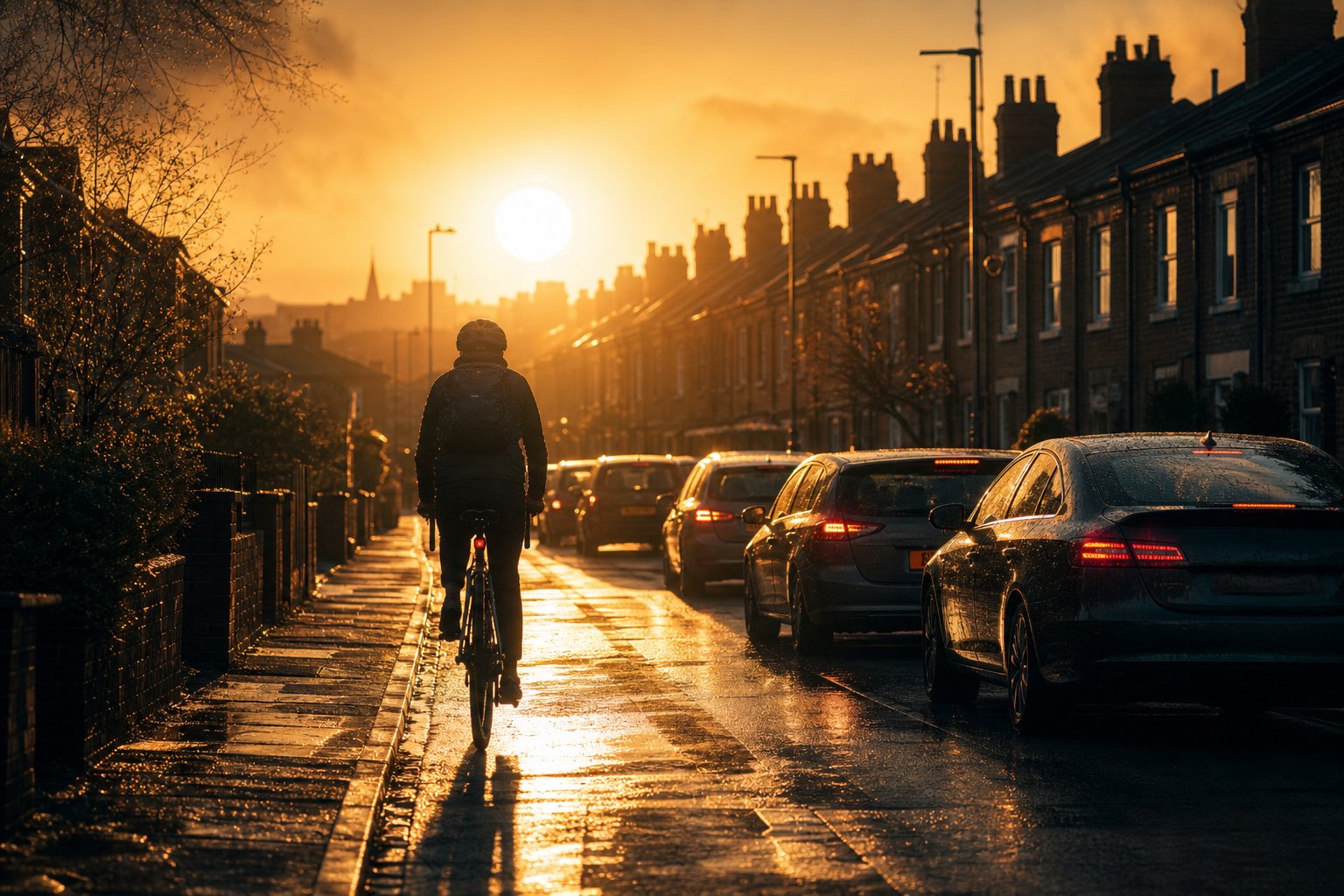
Low sun is the most dangerous light on British roads. Government casualty statistics analysed by Cycling UK show an average of 28 deaths a year where “dazzling sun” was a contributory factor — and 74% of those killed were pedestrians, cyclists or motorcyclists. From September to February, UK commutes line up almost exactly with sunrise and sunset. This guide covers how to see, how to be seen, and what actually helps at eye level.
Why autumn and winter commutes are the danger window
The UK’s winter sun never climbs high. Around the equinoxes and through winter, it sits within 15° of the horizon exactly when commuters are on the road — 7:30–9:00 in the morning and 16:00–17:30 in the evening. At that angle, light hits windscreens, wet tarmac and your eyes almost horizontally. Glare through a dirty windscreen can hide a cyclist completely; the driver is not being careless in that moment so much as genuinely blinded — which is why Highway Code Rule 237 tells drivers to “slow down and, if necessary, stop” when dazzled. The rule exists; your safety margin should not depend on every driver obeying it.
After the clocks go back in late October, the evening commute drops abruptly into this window. Every year the same pattern: a fortnight of near-misses while everyone recalibrates.
The two-sided problem
You being dazzled. Riding east in the morning or west in the evening means riding into the sun. Squinting costs you reaction time; a fully blinded second at 20mph is nine metres travelled unsighted.
You being invisible. The more dangerous half. When the sun is behind you, you can see perfectly — and the driver pulling out ahead of you is staring straight into it. The irony is brutal: the direction that feels safest to ride is the one where you disappear.
What helps at eye level
A visor-style peak or cycling cap under the helmet blocks the direct disc of the sun. But the glare field — bounce off wet roads, windscreens and road paint — comes from below and beside, and a peak does nothing about that. This is specifically the scenario polarised lenses were built for: reflected glare is largely horizontally polarised, and a polarising filter removes it selectively rather than just darkening everything.
For low-sun commuting we recommend, in honesty-first order:
- Polarised Cat 3 lens (our AeroShield Pro, £15.31) — best for bright low sun and wet-road glare, the classic crisp winter morning. This is our product and our lane.
- Photochromic lens (from ~£35 elsewhere) — better if your commute is half-shaded or you ride the dark end of twilight; see our honest comparison where we tell you when to buy this instead.
- A lighter Cat 1–2 tint for overcast gloom — glare can still be brutal under thin cloud, but a Cat 3 is too dark. Pick tints with our lens colour guide.
A wraparound shape matters more in winter than summer: low sun comes at your eyes from the side during junctions and roundabouts, and gaps around a flat fashion frame leak exactly that light.
What helps at bike level
- Daytime running lights, front and rear. Against a blinding sun, a pulsing light is the one thing that punches through glare to a driver’s eye. This is the single highest-value winter upgrade after eye protection.
- Route planning around bearing. An east–west A-road at 8am in November is the worst case. A parallel backstreet with tree cover or a north–south dogleg removes the direct-glare kilometres. Most riders can reroute 80% of the dazzle away for two extra minutes.
- Position and patience at junctions. When the sun is behind you, assume you are invisible. Make eye contact or assume failure; hold back half a second on green.
The condensation trap
Cold-morning specific: stop at lights after a hard effort and lenses fog. Vented shield designs clear within seconds of rolling again — ours included, and we say so plainly on the product page rather than pretending it never happens. The deep-dive fixes are in our fogging guide; the short version is airflow, anti-fog drops as a backup, and never wiping mid-ride with a glove.
Your low-sun checklist
| Risk | Fix | Cost |
|---|---|---|
| Direct dazzle | Peak/cap + polarised Cat 3 | from £15.31 |
| Reflected glare (wet road) | Polarised lens specifically | — |
| Invisible to blinded drivers | Pulsing front/rear lights | from ~£20 |
| Overcast gloom | Lighter tint second pair | from £13.78 in a 2-pack |
| Fogged lenses at stops | Vented shield + anti-fog | pennies |
FAQ
Is it legal to ride with dark lenses in winter? Yes, in daylight. Category 3 lenses are fine for daytime riding; no lens category is illegal on a bike. Common sense applies after sunset — swap to clear or ride without.
Polarised or photochromic for a winter commute? Bright, open, wet-road commutes: polarised. Half-shaded lanes and twilight finishes: photochromic. We sell only polarised and stand by that division — the full reasoning is in our comparison guide.
Do I need different glasses for morning and evening legs? Same glasses, different problem: mornings you are dazzled, evenings you are invisible. Lenses fix the first; lights fix the second. Budget for both.
The Spare Pair Rule. Winter is when glasses get sat on in cafés and dropped with numb fingers. A backup pair in the pannier costs £13.78 in a 2-pack — cheaper than one ruined commute.