Is Polarised Bad for Mountain Biking? The Honest Case Against It Off-Road
We sell a polarised shield and we'll still tell you when it's wrong — the honest case against polarised on tight, wet, technical mountain biking trails.
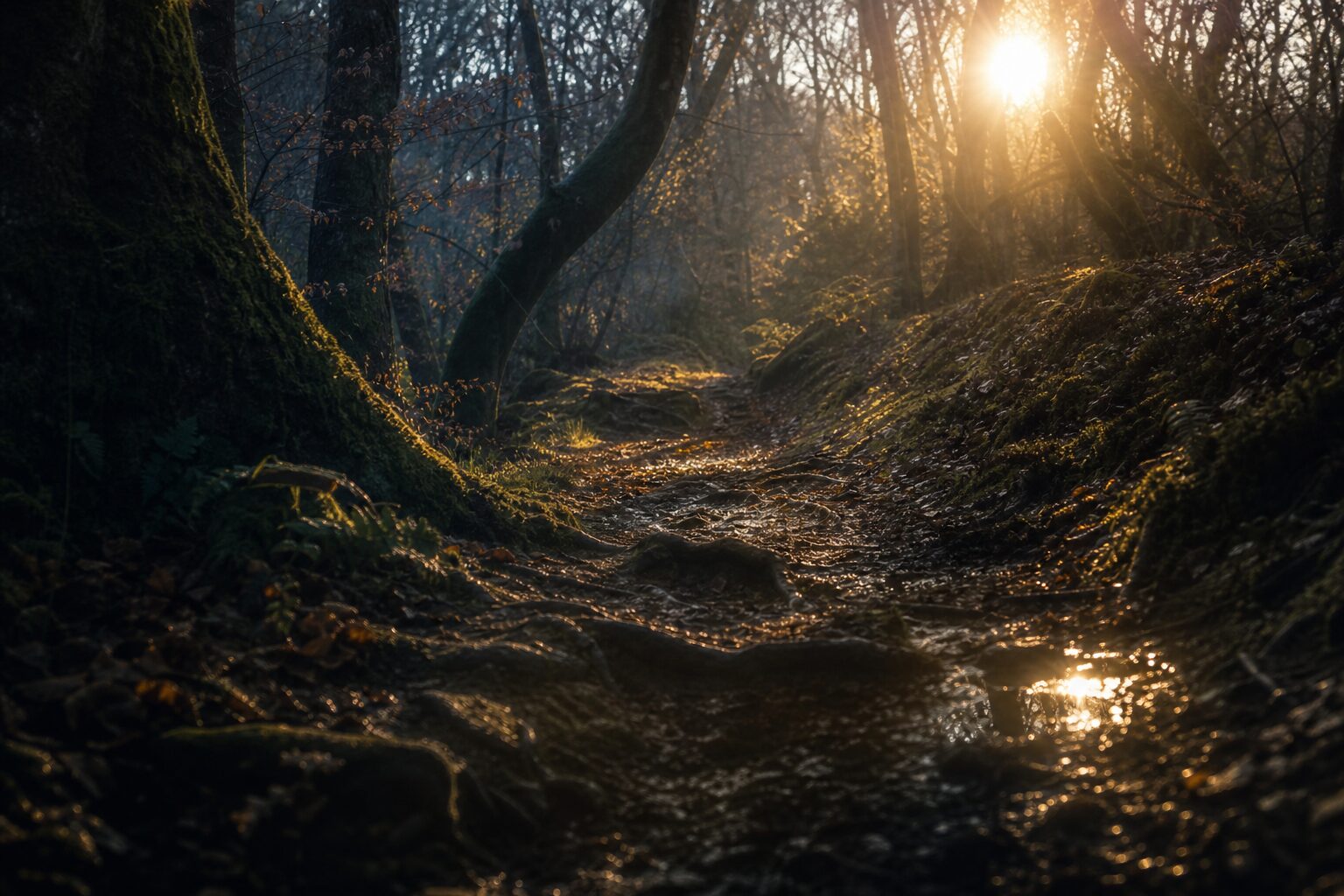
Often, yes. For tight, tree-shaded, technical singletrack, polarised lenses can be a genuine liability: by stripping out horizontally reflected light, they mute the tell-tale sheen on wet roots, greasy rocks and hidden puddles — the very cues that warn you a surface is about to let go. Out on bright, open gravel, moorland or a wet road with real glare, polarised is lovely. But for reading dark, rooty woodland, a lighter non-polarised contrast lens usually wins. We build a polarised shield, and we’ll still say that plainly.
How polarised lenses actually work — and why trails break the rules
A polarised lens is a vertical filter. It blocks horizontally polarised light, which is the harsh glare that bounces off flat, shiny surfaces: water, snow, wet tarmac, car bonnets. That is why it feels transformative on a coastal spin or a wet commute, and it’s the same physics we cover in our polarised vs photochromic cycling glasses guide.
Woodland is a different world. Light scattering off dry dirt, leaves and bark isn’t strongly polarised, so there’s very little “bad” glare to remove in the first place. A long-running MTBR forum thread puts it bluntly: a practising eye doctor explains that reflections off dirt and foliage aren’t polarised, so the filter mostly just darkens the woods — and blanks out your bike computer’s LCD at the wrong head angle. What glare there is off-road tends to be the useful kind.
Where polarised hides the trail: wet roots, puddles and greasy rock
Here is the honest problem. The sheen on a wet root or a slick rock is information. That glassy reflection is your brain’s early warning that a surface is wet and about to be slippery. Polarising damps exactly that reflection, so a treacherous root can read as matte, dry and grippy right up until your front wheel skates off it. Standing water is worse: a polarised lens can flatten a puddle’s surface glint, so a deep, brake-swallowing hole looks like harmless dark ground.
Add canopy to the mix and it compounds. Our AeroShield Pro runs a Category 3 lens at roughly 14% VLT — a sensible, sunny-day darkness — but any dark-ish tint plunges deeper into shadow under broken tree cover, and polarisation removes the reflections that would otherwise pick out edges and texture. No shade-specific transmission measurement is published for the polarised shield; it remains a Category 3 lens, so in genuinely deep tree cover the answer is more light — a lighter category or a clear lens — not more polarisation.
Do polarised lenses affect depth perception?
This one gets overstated, so let’s be fair. Controlled clinical work — including a peer-reviewed study on polarised sunglasses and visual function — has generally found no significant change in true stereo depth perception, visual acuity or contrast sensitivity versus non-polarised tints. So the idea that polarising “breaks” your 3D vision does not really hold up in the lab.
What does happen off-road is subtler, and still matters: by removing surface reflections, polarised lenses strip out texture and contour cues, so uneven ground can look flatter and more uniform than it is. Riders read that as lost depth even when their stereopsis is fine. On fast, technical trail where you judge a drop or a rock garden in a fraction of a second, losing those cues is enough to slow your reactions.
Black ice, frost and the early-season lane
The same mechanism that hides a wet root can hide something worse. Eye-health guidance — including from the American Academy of Ophthalmology — cautions that polarised lenses can make ice on the road harder to spot, because the glassy glare that distinguishes black ice from plain wet tarmac is precisely the reflection polarising removes. For early-morning autumn and winter rides on greasy lanes and frosted gravel, that is a real trade-off worth knowing. It doesn’t make polarised dangerous everywhere; it means the one visual clue you’d want on a frosty descent is the clue the lens is designed to erase.
What to wear instead — and where polarised still earns its place
If most of your riding is tight, dark, technical woodland, a non-polarised high-contrast lens will serve you better than any polarised shield, ours included. A lighter tint keeps shade usable, and a contrast-boosting tint helps roots and rocks pop — the approach we set out for exactly this light in our guide to contrast lenses for gravel and woodland. If you’re unsure which colour suits your trees-and-sky mix, our lens colour guide walks through it honestly.
Trail runners face the same fork. On open fell, moorland or coastal path in bright sun, polarised is comfortable and cuts real glare. On rooty, shaded forest loops, a lighter non-polarised contrast lens reads the ground better — so the answer to “are polarised sunglasses good for trail running” is genuinely “it depends on the terrain”.
None of this means polarised is a mistake. The AeroShield Pro polarised shield is at its best where there is real horizontal glare to kill: open gravel, fire roads, exposed moorland, road miles, the commute and coastal rides. Just know it is a fixed shield, not an interchangeable-lens system, so pick the tint for the riding you actually do most — you can’t swap lenses at the trailhead.
FAQ
Are polarised sunglasses ever good for mountain biking? Yes — in bright, open conditions with genuine glare, such as exposed gravel, moorland or coastal trails. It is tight, shaded, technical woodland where polarising can hide the wet roots and puddles you most need to see.
Do polarised lenses ruin depth perception on the trail? Not literally. Clinical studies find little effect on true stereo depth, but polarised lenses can mute the surface texture and reflection cues you use to read terrain, which feels like flattened depth on technical ground.
Are polarised sunglasses good for trail running? It depends on where you run. They’re pleasant on bright, open paths with real glare, but on shaded, rooty singletrack a lighter non-polarised contrast lens usually reads the ground more safely.
The Right-Tool Rule: match the lens to the light, not the label. For dark, technical trails choose a lighter contrast lens; for bright, open miles reach for the polarised AeroShield Pro — and keep a spare pair 2-pack in your bag so the right lens is always with you.