Cycling Glasses for Cloudy Days: Why "Darker" Is the Wrong Instinct
On flat grey days a darker lens is the wrong instinct. Here's what actually sharpens contrast on overcast UK roads — and when to skip the tint entirely.
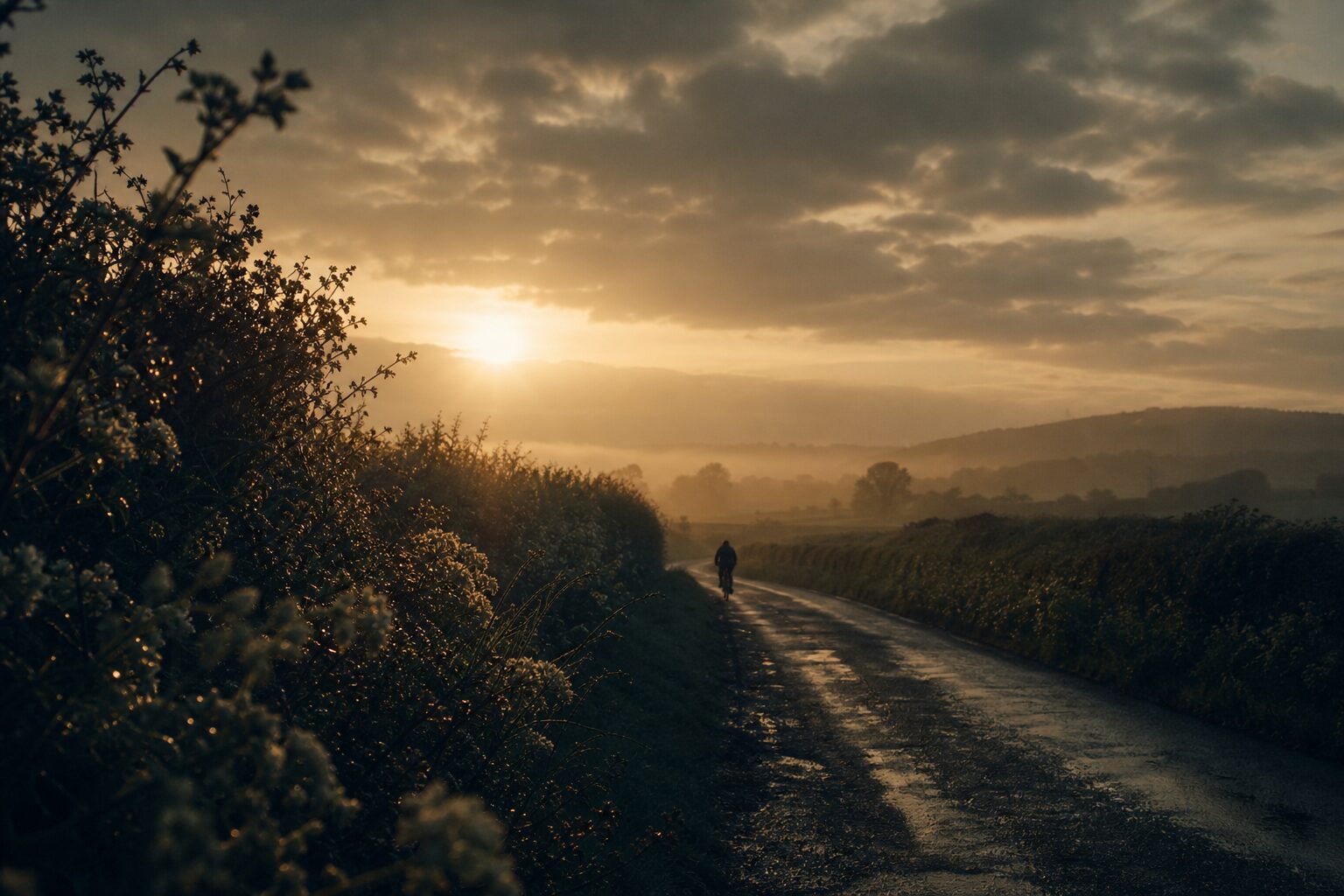
Choosing cycling glasses for cloudy days feels obvious — reach for a dark tint — and that instinct is usually wrong. Cloud doesn’t blind you with brightness; it flattens the road by scattering light evenly and stripping out the shadows your eyes rely on to judge depth. What helps on a flat grey day is more contrast, not less light: a lighter, contrast-boosting tint such as amber or rose, or on the gloomiest days a clear lens for protection alone. Go darker on a dull day and you simply make a grey world gloomier — and risk missing the pothole you didn’t need hidden.
Why grey days flatten the road (it isn’t brightness)
Two things happen when the cloud sheet closes in. First, light stops arriving from one direction and scatters across the whole sky, so shadows vanish. Shadows are information: they tell you where the surface dips, where the kerb edge sits, where a shiny patch is a puddle rather than a pothole. Lose them and the tarmac reads as one even grey plane, even when it plainly isn’t. Second, diffuse cloud light skews towards blue, and blue is the wavelength that muddies your sense of contrast. So the real enemy on an overcast ride isn’t glare — it’s a quiet loss of definition.
That is exactly why “darker” backfires. A dark lens cuts overall light without restoring any of the missing contrast; it just dims a scene that’s already dim. Tints that filter blue — amber, copper, rose, yellow — do the opposite. They knock back the flattening wavelengths and let browns, greens and greys separate again, so the surface regains its texture and edges.
The best lens tint for overcast cycling
On a genuinely dull, mid-grey day a light contrast tint beats a dark one every time. A long-running Road Bike Review forum thread on lens colour for overcast days lands in the same place: riders trade notes on yellow, persimmon and amber, and almost nobody argues for a darker smoke lens — the only real debate is which light tint wins. It tallies with mainstream sports-optics guidance, which recommends amber and rose tints for weak or absent sunlight and reserves very dark lenses for bright glare.
A quick way to match lens to sky:
- Bright, white overcast or wet roads: a dark polarised lens (Cat 3) to kill glare and sheen.
- Flat mid-grey, dry: a light amber, copper or rose contrast tint (Cat 1–2) to rebuild definition.
- Deep gloom, dawn or dense trees: a yellow or clear lens — or a photochromic that clears right down.
So the best lens tint for overcast cycling is a light one that filters blue: amber and copper for most grey days, yellow for the truly gloomy, clear when it’s darker still. Our lens colour guide maps each tint to the sky it suits. And if your cloudy miles run through trees — where flat light gets worse, not better — the same reasoning drives our take on contrast lenses for gravel and woodland.
All eight AeroShield colours are sold under one manufacturer rating — Category 3, nominal 14% VLT — with no per-colour spectrophotometer table published, so for genuinely dim days the answer is a lighter-category lens, not a different Cat 3 tint.
Where a dark polarised lens still earns its place
Not every cloudy day is dim. “Bright overcast” — that white, glary sheet where you squint even though the sun is nowhere to be seen — throws plenty of light, and a wet British road beneath it turns into a mirror. That is a job for polarisation, which strips the horizontal glare bouncing off wet tarmac and standing water. Here a Cat 3 polarised lens like the VeloVisor AeroShield Pro genuinely earns its keep: it tames the sheen so the surface reads clearly again. The same tool helps against low winter sun, which on our short days so often breaks through the very cloud that spent the morning flattening everything.
Be honest: one fixed lens can’t cover every sky
Here’s the catch we won’t dodge. The AeroShield Pro uses a fixed shield lens — it does not swap out. Its Cat 3 polarised tint (about 14% light transmission) is built for bright, glary conditions, so on a genuinely dark, gloomy day it is darker than ideal, and no marketing spin changes that. If most of your riding is deep overcast, dawn starts or dense woodland, an interchangeable or photochromic set-up that clears to a pale lens is honestly the better tool — and we’d rather say so.
For everyone else, the reality is cycling glasses for changeable UK weather, where a single loop can swing from bright cloud to drizzle to a stab of low sun. No one tint owns all of that. The practical answer isn’t one perfect lens — it’s two pairs, and reaching for the right one as the sky turns.
FAQ
Do I need sunglasses on overcast days when cycling? Yes, though mostly for protection and contrast rather than darkness. Even under cloud there’s UV, wind, grit and the odd fly, so a clear or light contrast lens shields your eyes and sharpens the road without dimming it.
What is the best lens tint for overcast cycling? A light, contrast-boosting tint — amber, rose, copper or yellow — filters the blue light that flattens grey scenes and restores definition. Keep dark smoke and Cat 3 lenses for bright glare and wet-road sheen, not for gloom.
Are polarised glasses any good on cloudy days? On dim, flat days a dark polarised lens is usually more than you need. But on bright overcast and wet roads, polarisation cuts the glare off wet tarmac far better than tint alone — so it depends which kind of cloudy day you mean.
The Two-Sky Rule. Keep a dark polarised lens for the bright, glary, wet days and a lighter one for flat grey, and carry both with a spare pair so the weather never dictates your ride — starting with the AeroShield Pro for the days when glare, not gloom, is the enemy.